Explore Mount Athos
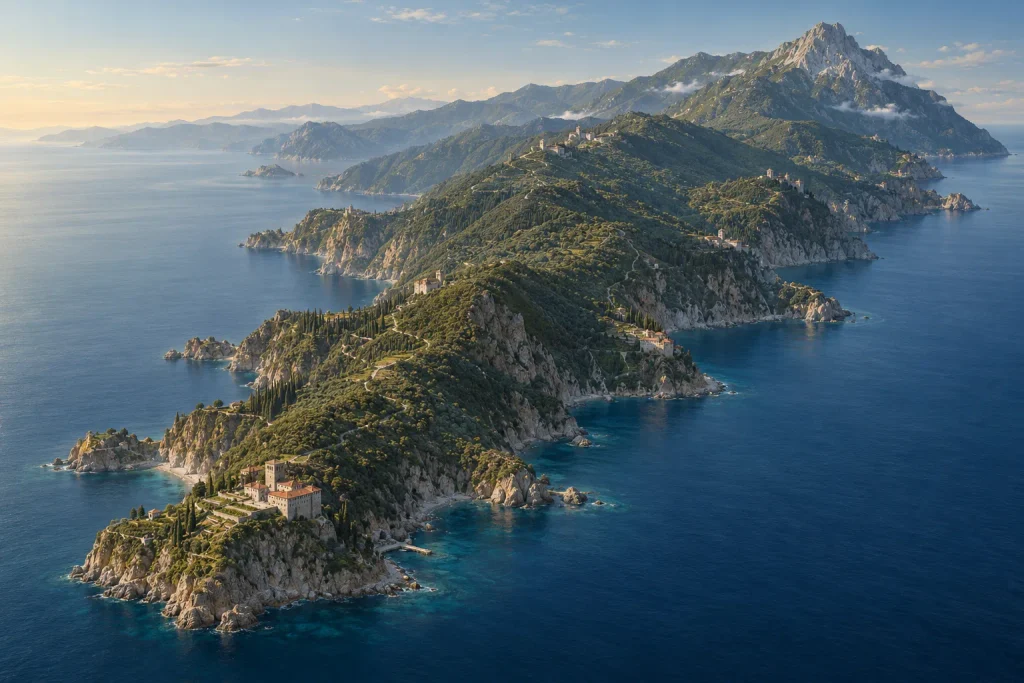
For Orthodox Christians around the world, a pilgrimage to Mount Athos (Hagion Oros) is an immersive journey into a living tradition of prayer, silence and spiritual devotion. For more than a thousand years, the Holy Mountain has been one of the principal centres of Orthodox monasticism. A defining moment in its history came in 963 AD, when Saint Athanasius the Athonite founded the Monastery of Great Lavra, helping to shape the organised communal monastic life that continues on the peninsula today. Its monasteries preserve an extraordinary heritage of Byzantine architecture, icons, manuscripts and sacred relics.
Mount Athos is also known as the “Garden of the Virgin Mary”. According to Orthodox tradition, the Mother of God was travelling to Cyprus with Saint John the Theologian when a storm brought their ship to the shores of Athos. The tradition relates that Christ granted the land to her as her garden and spiritual inheritance. This devotion remains central to Athonite life: the monks honour the Mother of God as the protector and spiritual guardian of the Holy Mountain.
Today, Mount Athos comprises twenty sovereign monasteries, together with numerous sketes, monastic cells, hermitages and other dependencies. Alongside the Greek monasteries, Bulgarian, Serbian and Russian communities have a long-established presence, while Romanian monastic life is represented mainly through sketes and monastic cells. The Holy Mountain is a self-administered monastic region of Greece under the spiritual jurisdiction of the Ecumenical Patriarchate of Constantinople. In 1988, it was inscribed on the UNESCO World Heritage List for its cultural and natural significance.
A visit requires advance preparation and respect for the monastic way of life. Under the avaton, the longstanding rule governing access to this male monastic community, women are not permitted to enter Mount Athos. Male visitors must obtain a diamonitirion, the official permit authorising entry and a stay for specified dates, through the Mount Athos Pilgrims’ Bureau. Overnight accommodation must also be arranged directly with the monasteries or sketes; the permit alone does not reserve a place to stay. Visitors should confirm their arrangements before travelling and respect the community’s worship, dress requirements and daily rhythm.
Karyes and Dafni: two key stops on Mount Athos
Dafni is the main port of Mount Athos, while Karyes is its administrative and transport hub. Discover two places that many pilgrims encounter at the beginning of their Athonite journey.
Explore Mount Athos with the Atlas
Mount Athos Atlas was created to make this remarkable landscape easier to understand and explore. It brings together information about 133 active locations, including monasteries, sketes, monastic cells, settlements, arsanades (monastic harbours) and other important places, together with 394 walking-route options connecting sites across the peninsula.
Through the Atlas, visitors can explore the geography of the peninsula, learn about its monastic sites and examine the paths that connect them. The Route Planner helps users compare available routes, distances and elevation profiles before deciding which option may suit their journey. The initial public edition is available in English and Greek for pilgrims, researchers and anyone interested in the spiritual, historical and natural landscape of Mount Athos.
Plan Your Journey with Care
Mount Athos Atlas is intended for research, orientation and preparation. Routes, access arrangements and conditions on the ground can change. Before setting out, visitors should check the weather, confirm access and accommodation arrangements, follow local signs and observe any instructions issued by the monasteries and the competent authorities.